So the “consultants’ report” is in on the Survival Center. Among the recommendations: they should have social workers on staff, child care for board members, and a new location. As luck would have it, I believe that magical money tree they planted out back is just starting to blossom.
It would have been nice if the consultants had focused on how to help the Center get through this crisis in a way that ensures they stay true to their mission and history, and to help them see through the noise and opportunism of this continuing assault to recognize the legitimate issues.
Instead, according to the paper, they get more piling-on of criticism, and a list of expensive “fixes” all aimed at turning the Center into an entirely different kind of an agency.
Why don’t “they” just start from scratch, and create this “ideal” new agency from the ground up? Why did the Survival Center have to fall in order for this vision of a new agency to emerge?
Providing social services is not a zero-sum game.
Wednesday, September 27, 2006
And every child should have a pony

Friday, September 22, 2006
More Survival Center stuff
Recent events have reinvigorated what had been a stalled discussion. Be sure to check out the comments section of the following post, or click here to bring up the post with all its related comments at the end. And please add your own thoughts and opinions as well.
Continue reading...Tuesday, August 22, 2006
Paved with good intentions
The most extraordinary local news topic lately has been the situation at the Amherst Survival Center. The newspapers are full of inflammatory allegations and supposed “human rights violations.” Reports have been issued by Town agents. “Recommendations” have been made with written response required. Concerned citizens are banding together to restructure the place. The Select Board is being called upon to appoint a new Board of Directors.
Crisis! Chaos! Drama!
Excuse me?
I served on the Survival Center’s Board for almost five years, from 1998 – 2002, the last two as Board President, and remained on various committees into 2003. During that time, I and others worked hard to improve its financial, organizational and procedural structure. Some of our efforts were effective, others never were.
I was focused on what I saw as the place’s enormous untapped potential. Operations could run more efficiently, services could be provided in better ways, the population served could be expanded, more money could be raised, if only...
If only. There were myriad “if onlys,” and they frustrated me beyond belief.
After five years of trying and failing to persuade the necessary majority of the Board (whose membership changed much over that time, as terms expired and new people joined) to embrace my views of progress and improvement, I eventually resigned, burned out and glad to be leaving, and disappointed by what I couldn’t accomplish.
And you know what? That is exactly how that should work. I would have preferred a different result, but I have no complaints about the process. As a Board Member seeking change, the burden of convincing others to support my ideas was on me, and I was unable to do that. The majority won, and the minority lost and I was in the minority. Done deal, fair and square.
Eventually I realized that I was trying to make the place be something it was not. There was no obligation for it to conform to my ideal. And just because it had the opportunity to be something different, did not mean it had the responsibility to do so.
So then this brouhaha started a few weeks ago. Some (but not all) of the “recommendations” being bandied about are things I agree would improve the place, or are issues I supported strongly when I was on the Board. So you’d think I’d be happy about all this, happy to see the changes I’d sought way back finally seeming possible. But I’m not. Because the process is so wrong.
It is wrong because the place’s reputation and 30-year history of vital service to the community are being dragged through the mud by the unfounded allegations of a few angry people, which have spun out of control and devolved into an excuse to complain, criticize and disrespect anything at all about the Center. That is a disgrace, and the place, its staff, consumers and supporters deserve better.
It is wrong because regardless of “good intentions,” no outside individual or entity has any right whatsoever to impose its views on the place. The Survival Center is a private non-profit organization. It can be anything it wants to be. It can run any way it wants to run. Its Board of Directors has the only say here. Anyone who doesn’t like the place is free to not contribute money, goods, etc., but that is where that power ends.
It is wrong because, in my opinion, the Town and its agents are way out of bounds with their inappropriate behavior and statements in so many facets of this: misusing their power and their processes, distorting “facts,” blowing small details out of all proportion and invoking “confidentiality” to avoid accountability.
It is wrong because the newspapers are letting wild accusations go unchallenged, ignoring all question of possible agendas, axes to grind and conflicts of interest.
It is wrong because so much of what is being written and discussed indicates a fundamental misunderstanding of the agency. I can’t begin to clarify all that here. But suffice it to say, the place is not about being everything to everybody. It is not about the people who don’t go there, or the services it doesn’t provide. It’s about the people who do go there, and the services it does provide, and there is much good in that.
The Survival Center, like any entity, could surely benefit from some changes. But not like this. If we start embracing the philosophy of “the ends justifying the means,” we will not like where we end up.
Tuesday, July 18, 2006
Fall Town Meeting dates
Mark your calendar. Fall Town Meeting starts October 30, 2006. Other dates the auditorium is reseved are: November 1, 2, 8, 9, 13, 15, 16, 27, 29.
August 18 at noon is the deadine for submitting Zoning Bylaw Amendment petition articles for the warrant.
September 8 at noon is the deadline for submitting miscellaneous petition articles for the warrant.
Petition articles require 100 signatures and must be submitted to the Select Board's office.
Wednesday, July 12, 2006
Media sensation
Front page of the paper this week. That was kind of weird. But of course, it’s not like this is my first time. These things just seem to happen every 30 years or so.
At least that time, my picture wasn’t next to a headline proclaiming “Second shooting suspect arrested.” Fortunately, there hasn’t been too much confusion on that issue so far.
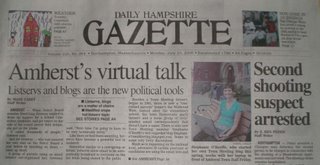
You can click on the pictures to enlarge them.
Friday, June 23, 2006
Wrapping up - Random Bits
Short shrift: I’m curious about the effect the ordering of the articles has on the voting. That which comes later in the meeting – or later in the evening – can’t possibly get the same thorough consideration as early stuff – we’ve burnt ourselves out. And some people end up leaving during each session so there aren’t even as many folks left to consider and vote on some issues. And as others have pointed out, having revenue-generating articles follow budget articles might yield very different results than the opposite order.
New view: Try sitting in different places once in a while. It is amazing how different the chatter is, and that can be really eye-opening. And sometimes it can drive you nuts.
Being vocal: Some folks have the most wonderful voices and speaking styles that I could listen to them all day, regardless of whether or not I agree with what they’re saying. On my list are: Isaac BenEzra, Elaine Brighty, Hwei-Ling Greeney, Alan Root and Eva Schiffer.
TM trivia: Guess how many pairs/groups of people we have in TM who share the same address. In other words, how many couples/roommates, etc. serve on TM together? I am including Ex-Officio members. (The answer is below.)
Shades of gray: A friend and I often voted quite differently. In talking about some of those issues, I found we really were in almost full agreement about them, but some small element of the issue itself or the motion dealing with it caused us to vote opposite. Perhaps there is often greater underlying agreement than the voting results would suggest.
Insights and incites: There is a wealth of information to be gleaned from the various e-mail listservs. A couple are specific to TM topics, others to the schools and Amherst in general. All are great resources for asking questions, getting informed answers – often from very different view points, and for being exposed to information and ideas not otherwise accessible. As an added bonus, you sometimes get to witness shockingly personal battles being waged “in public.”
Duly noted: Among the problems with the TM articles that seek to “advise the legislature,” or whomever, is that they are so obvious. This is Amherst. We conform to our stereotype pretty well. The folks in Boston know how our town would weigh in on issues related to war, social justice, alternative anything, etc. We don’t need to “let the record show ...” The record is clear. If we really want to be heard, we ought to save our advisory articles for issues on which our position would be unexpected.
TM trivia answer: 31. That’s 31 households which have more that one member in TM, comprising 63 TM members. That’s a higher number than I expected. You don’t really notice it as you look through various lists, partly due to differing last names.
Humor me: With Spring TM over, other members might now be able to spend a little time considering starting their own blogs before Fall TM. It is simple and free, and it would be so great if we could link a bunch of them together for a really full examination of the issues from different perspectives. Yours wouldn't have to be the same format as mine – you don’t need to recap everything unless you want to. Maybe you would just want to list your opinions or your votes. Maybe occasionally you would want to really spout off about something. Who knows? There are so many possibilities. At least see how the process works. Go to www.blogger.com. It will walk you through 3 simple steps – creating an account (no credit cards, no addresses, nothing like that,) naming your blog, and choosing a template. Voila – you have a blog! Try one just as an experiment. If you don’t like it, you always have the option to delete the entire thing, or just leave it there and ignore it – no one will even know. Then you could try again and make another. Play around with it. It is so easy and you have nothing to lose.
That’s all she wrote: So I think I’ve said everything I have to say about this TM season. As I mentioned in the post about the final session, if other issues related to TM come up before Fall TM, I will probably add my two-cents here. Will I weigh in on other issues also? I don’t really know. You might check back occasionally, just in case. (Also – do check to see if people have added new comments.) Otherwise, enjoy the summer and again, many thanks!
And there are several more wrap-up posts below this one, so don't miss those.
Wrapping up - Voting
Here are the complete tally vote records:
Arranged alphabetically
Arranged by precinct
Going solo: Number of people whose tally vote record was exactly the same as mine: 0
Had I not strayed: Number of people whose tally vote record was exactly the same as mine, except for the motion to reconsider: 10 (Bertrand, Blauner, Carlozzi, Kelley, Laraja, Moran, Moran, Morton, Schiffer and Slaughter)
And here’s my complete voting record, not just the tally votes. (Coming soon.)
Wrapping up - Attendance & Vote Totals
Present and accounted for: Attendance by session: May 1 – 187; May 8 – 196; May 10 – 175; May 15 – 201; May 22 – 192; May 24 – 183; May 30 – 176; June 5 – 163; June 7 – 164; June 12 – 172; June 14 – 177; June 19 – 160.
Of leavers and abstainers: Tally vote totals in relation to attendance: May 1 – 167 out of 187 present; May 10 – (3 tally votes) 165, 160 and 151 out of 175 present; May 15 – 193 out of 201 present; May 22 – 173 out of 192 present; May 24 (2 tally votes) 178 and 172 out of 183 present; May 30 – 163 out of 176 present; June 5 – 157 out of 163 present; June 7 – 154 out of 164 present; June 12 – 154 out of 172 present; June 14 (3 tally votes) 170, 170 and 171 out of 177 present; June 19 – 150 out of 160 present.
Wrapping up - Attendance Extremes
Honor roll: The following TM members get gold stars for perfect 12/12 attendance this spring: Arnold L. Alper, Anne S. Awad, Liv Baker, Isaac BenEzra, Clare E. Bertrand, Patricia Blauner, James A. Brissette, H. Oldham Brooks, Calvin L. Brower, Nonny Burack, Isabelle M. Callahan, Alice A. Carlozzi, James I. Chumbley, Patricia K. Church, Barbara C. Ford, John O. Fox, Richard Gale, Stanley F. Gawle, Marilyn A. Gonter, Michael L. Greenebaum, Grace A. Griecci, Ralph P. Hill, Robie Hubley, Larry J. Kelley, Mary W. Kersell, Robert B. Kusner, Taryn S. Laraja, Joan Ross Logan, Leo C. Maley III, Jenifer E. McKenna, Jane K. Mellor, Andrew T. Melnechuk, Kay J. Moran, Brian D. Morton, Kenneth R. Mosakowski, John Musante, Vincent J. O’Connor, Stephanie J. O’Keeffe, James W. Pistrang, Alan W. Powell, Deanne Sloan Riddle, Alan Root, Irving P. Rothberg, Julia Y. Rueschmeyer, Marcy A. Sala, Eva Schiffer, Marcie Abramson Sclove, Douglas Wesley Slaughter, Mary Streeter, Charles J. Traitor, Fil Valiunas, Gerald S. Weiss, Molly Kirsten Whalen and Walter J. Wolnik. (54 total)
Honor roll, part II: Also praiseworthy are those folks who became members during TM, and then had perfect attendance: Anne Sterling Bush, Robert J. Crowner, Irwin Friman, Adele G. Levine, Susan C. Pynchon and Ryan Quinn. (6 total)
M.I.A.: Missing person alerts are being issued and search parties dispatched for the following members who never showed up at all: Christopher D. Bascomb, Pamela Brown, A. Edward Cutting, Kevin C. Gale, Woden B. Kusner, Carol Lee, Patrick D. MacLeod, Strider Rubeck, Morris Abraham Singer and Michael Joseph Waskiewicz. (10 total)
For complete attendance records, click here.
Tuesday, June 20, 2006
The End
Could we possibly finish? There was still a lot to do. I was betting on Wednesday myself. More pessimistic types thought next week. The optimists said it had to be done last night.
So the twelfth session of Town Meeting actually began with the second session of the May 24th Special Town Meeting, which had been called and immediately adjourned until after Article 34 of the Annual TM.
This one-article warrant sought to appropriate $16,000 of Community Preservation funds for the purpose of paying for appraisals and surveys of land that the town is considering acquiring or protecting. Such studies typically cost $4000 - $6500 each, and are often funded with assistance from groups like the Kestrel Trust, or from the land owner. There were a few general questions about conservation land – about the ability to see a map showing parcels intended for protection (yes, just go to the Planning and Conservation Office,) the amount of land the town currently owns for conservation or protects with Agricultural Preservation Restrictions (about 2000 acres of each) and whether after paying for land studies the Town ever declines a parcel (occasionally.) The vote to approve is nearly unanimous, and I was among those voting in support.
Special TM dissolved. Back to the Annual TM.
Article 35 sought to appropriate $20,000 of Community Preservation funds to study and plan coordinated signage for the town’s parks, recreation fields and adjoining conservation lands. The current signage identifying such spaces and providing useful information ranges from inadequate to nonexistent. This article was brought by the Community Preservation Act Committee which is responsible for collecting requests for CPA funds and determining their eligibility and priority within the four areas of allowed spending (open space, historic preservation, affordable housing and recreation.) The Finance Committee supported the article, but the Select Board opposed it. Among the SB concerns was their usual committee meddling type stuff – seems like too much money, want more info on how many signs, what would they look like, what would they cost, what would they be made of, etc. (You know, the kinds of questions one might be able to answer after having done a sign study . . .) They also objected to including the Design Review Board in the process, believing this to be outside their purview, though they were quickly assured that this is just the sort of thing the DRB does and must do. Amidst all this was also one strong and defensible argument – that this is the sort of thing that should be done by the Public Works department, and should fall under regular town funding, not CPA funding. A reasonable position, though I would still defer to the committee, whose purpose is the diligent distribution of these funds. Members weighed in on both sides. One suggested a sign competition among volunteer carpenters as an alternative. Another felt the money could be better spent on a map or booklet with all local park and rec info. Another felt signs were good advertising and would increase awareness and usage of the areas. The voice vote was too close to call, so we had a standing vote, resulting in 78 supporting the motion, 72 opposed. I voted in support.
Article 36 was the final action for balancing the FY07 budget – the transfer of $1 million from the stabilization fund. Our previous budget votes were predicated on this use of reserves. The Finance Committee reiterated that this was the final year of a multi-year plan for using reserve funds this way, and that TM has consistently supported this plan. The Select Board supported this 4-1, and talked about their long discussions regarding whether or not only $500,000 of reserves should instead be used, before ultimately agreeing with the FC. A member suggested that there is actually an additional million dollars in reserves that the FC isn’t telling us about, and pointed out that we would soon be credited with more than $600,000 that had previously been debited us by the state, because of a past situation with our health claims trust fund. The FC said the assertion about an extra million was false. Another member questioned how our future reserves could be growing at the rates the FC projects. It was explained that increased revenues from new growth are expected, the aforementioned credit from the health claims trust fund is included, and the turnback of funds that had been budgeted but not used, all contribute to the gradual rebuilding of the reserves as projected. Another member made an interesting point about the impracticality of our current process for dealing with the budget, where we finalize each appropriation as we go along rather than treating each appropriation as preliminary and finalizing the entire figure at the end. There were various concerns about inadequate reserves, the cost of debt service, worsening conditions for the next budget, and the familiar refrain of “get more money from UMass and the colleges!” The vote to appropriate money from the stabilization fund requires a 2/3 majority, and it passed easily. Yes, I supported it.
Article 37 was about appropriating money from Free Cash to the General Fund, but as this was unnecessary, the article was dismissed.
After disposing with Article 37 so quickly, the FC chair used the extra time to thank different people who assist so vitally in the budget and TM process, and we thanked them with our applause. I apologize that I did not catch all their names, because I would have liked to include them here. (UPDATE: Joyce Karpinsky, Libby Lass and Gail Weston are those good folks we were applauding. Many thanks to them!) Thanks and appreciation were then showered on John Musante, who has been filling the role of interim Town Manager while also performing his Finance Director duties. He received much praise from the FC and SB, and a standing ovation from TM.
We were moving through all this pretty well. We might really finish this up!
Article 38 was brought by the Select Board and sought to put on the November ballot a proposal to increase the CPA property tax surcharge by half a percent. State law allows a CPA surcharge of up to 3%, and ours is 1%, so this would raise us up to 1.5%. Their reasoning was that next year this would bring in around $113,000 from taxation which would be matched 100% from state funds, for a total of $226,000 in increased revenues which we could then use for capital projects like restoration work on Town Hall and the Jones Library, freeing up operating budget funds. Paying for repair and maintenance of town property with CPA funds – clever. But wait – didn’t the SB just oppose the CPAC’s recommendation for using CPA funds for a signage plan, saying that money should come from the operating budget? Some might say that isn’t logically consistent, but what do I know? Perhaps the difference is that the SB wants to decide what is and isn’t eligible for CPA funds. The SB’s micromanagement of committees does, I’m afraid, have a certain consistency to it.
Kiss my chances for a town committee appointment good-bye, huh?
Beyond that nonsense, this is a tough issue. On the one hand, it really is a tiny increase, it benefits from being matched with state funds, and the benefits of CPA spending in the community are terrific in every category. On the other hand, there is a real sense of an increasingly oppressive property tax burden in the community, and a very strong likelihood of needing to ask voters for another override soon in order to pay for basic town services. Sure, voters can oppose the CPA increase if they want to, but whether it passes or fails, to follow it with an override request will inevitably have the effect of “here we go again.” If we only seek an override by dire necessity, wouldn’t we want to give it the best possible shot at passing? Does it make sense to precede a need with a want? That negative outweighs the various positives of this proposal for me.
The Finance Committee opposed the motion, saying that it should be considered in a larger context addressing all the financial problems and plans.
The CPAC supported it, but what body ever opposed giving itself more money?
People made the predictable and the previously mentioned arguments for and against. Ultimately, it passed in a tally vote of 89 supporting, 61 opposing, and I voted to oppose.
Article 39 sought to “strongly urge” the Select Board to seek an “RFP for the lease and/or management of the Cherry Hill Golf Course by private entities.” The petitioner of this article is a TM member who wants the Cherry Hill budget to never be a TM issue again. He asserted that privatizing management would still enable golf to be affordable to the whole community. Neither the SB nor FC took a position on the article. A shy and quiet fellow shared with us some up-to-the-minute Cherry Hill financial figures he just happened to have in his pocket. In keeping with the established pattern, those numbers were then re-framed and re-interpreted for us by Mr. Musante. Another member spoke of his desire to maintain town ownership and not “exploit” this “resource.” We had a standing vote which passed with 72 supporting, 62 opposing. I voted in support.
Article 40 sought to have the Town Manager compile and keep updated a fact book of key town data and information, providing easy access and a “common foundation for decision making by Town Meeting members and other town officials.” Everyone supported the concept, though the FC downgraded their initial stance from “recommend” to “no recommendation,” feeling the budget situation made this an inopportune time for it. The SB wanted to refer it to the TM Coordinating Committee, but some argued that it was outside the committee’s purview, and the motion to refer was defeated. The vote to support the main motion passed resoundingly, and I was among those supporting it.
The end was in sight. But it was 10:00, so if we were to forge ahead, any new article required a motion to that effect. We got one, it had full support, and we moved on to Article 41.
This article sought to request from the Select Board a five-year financial projection for level town services “with rationale for each” and the proposal of “sustainable strategies” to support those projections, all to be shared with Town Meeting. Again, most everyone supported this concept, and discussion focused on specific language of the article’s terms, which was ultimately edited to satisfaction. After the vote, those words again: “The ayes have it, the motion passes.” I voted in support.
Article 41 was the last article on the warrant, but long, long ago in a galaxy far, far away, we had voted to defer article 19 until after article 41, so we weren’t quite done yet.
Article 19 sought a zoning bylaw change, to regulate where drive-through facilities can and cannot be located. Apparently this was previously unregulated, and that is why the resulting drive-through chaos ensued. Or whatever. At this point in the evening and the meeting, a zoning change allowing Wal-Mart on the town common might well have passed. After brief explanation and briefer discussion, this motion which required a 2/3 majority passed unanimously.
And thus ended Amherst’s 247th Annual Town Meeting.
Whew.
Random Bits
More pictures tonight – this time of all the sad park and rec signs, or lack thereof. Not quite the sewage treatment plant, but hey.
Rumors that our earlier bad behavior had driven the moderator out of town never to return, proved to be false. Rumors that he came home to find the interim moderator waiting on his front step, desperate to return the gavel, are unconfirmed.
Quite a crowd gathered at ABC for refreshment after the meeting. Luckily, the giant orchestra that was playing when we arrived soon finished their set, allowing for actual conversation. It was great to chat, put faces to names, and commiserate over this long crazy process.
So now what? What becomes of the blog? Good questions. There will be some wrap-up stuff in the next few days, so do check back. After that, it’s kind of hard to say. We definitely don’t want this to devolve into “Stephanie’s random thoughts on everything.” Issues relevant to TM will continue to come up occasionally, and I will probably weigh in on those, and then presumably pick up more or less like this with the fall TM. Just sorta see how it goes, I guess.
Let me say now that this has been a real kick. I had no idea how this was going to go, and it has blown me away. I’ve learned so much from so many, and connected with incredibly nice and interesting people, all because of the blog. Thank you very much for reading, for commenting, for e-mailing and for all your kind words.
And with that, I think my 15 minutes are just about up.
Saturday, June 17, 2006
Tally ho!
For your analyzing pleasure, here are all the tally votes related to Article 23:
The original from 5/10.
The motion to reconsider, 6/14.
The motion to refer back to the Planning Board, 6/14.
The final vote, 6/14 .
Here’s some breakdown regarding the main motion:
Regarding absence/abstention
51 people were absent or didn’t vote on the Article 23 main motion both sessions.
25 people who were absent or didn’t vote the first time voted in support of the motion this time.
22 people who were absent or didn’t vote the first time voted to oppose the motion this time.
18 people who voted in support the first time were absent or didn’t vote this time.
9 people who voted to oppose the first time were absent or didn’t vote this time.
Changed their votes
8 people who voted in support the first time voted to oppose this time.
4 people who voted to oppose the first time voted in support this time.
Didn’t change their votes
73 people voted in support both times.
39 people voted to oppose both times.
Reconsideration
15 people voted against reconsideration but then voted in support of the final motion.
2 people voted for reconsideration and then opposed the final motion.
Click here for the lists of member votes, arranged by the preceding categories. The final category I listed above about reconsideration is not broken out separately, but those votes are included in each member's voting line.
Many thanks to my husband for his wicked Excel skills.
And don't miss all the interesting discussion going on in the comments section of the "Déjà vu all over again" post.
Thursday, June 15, 2006
Déjà vu all over again
The guts of last night’s meeting were devoted to a technicality.
Apparently, upon meeting an absurdly low threshold for “new information,” any article from the current Town Meeting can be reconsidered if it is so moved by a member who voted with the majority, abstained or was absent during the initial consideration.
This is really great news. We have 70-100 people absent each session. Think of the possibilities! Amherst’s 247th Annual Town Meeting might well go on in perpetuity.
And so a member absent the first time and now present for his fourth session so far (out of eleven) moved that we reconsider Article 23, the one about fixing the Professional Research Park zoning designation to allow “quiet businesses” to meet with clients on site, if such client visits are primarily by appointment.
Let’s be perfectly clear here: I support this zoning change. I am disappointed and frankly mystified by the opposition to this. But I did not support its reconsideration.
Why not? So many reasons. This met the “letter of the law” allowing reconsideration, but it in no way met the spirit. If you condone misusing reconsideration in this way now because it serves your purposes, you lose the moral authority to oppose such misuse by “the other side.” Anything that exploits absence for benefit is odious to me. Heck, if just a couple more people who supported this change had not been absent the first time, we wouldn’t even have this problem. But they were absent, and that resulted in a loss, and that should teach us all a lesson: you need to come and vote every night folks – that’s what this is all about. And you also have to accept defeat. Democracy doesn’t mean you always get your way.
The new information claims were also particularly lame: Having now gone through the budget, we know what bad shape we’re in, and people might have voted differently the first time if they had known it would be so bad. If there are TM members for whom that is true, it does not bode well for the body.
A lot of the arguments against reconsideration were just as bad, and it pained me to be allied with them. How can we reconsider this when we don’t even remember what this issue is about? We didn’t bring our paperwork on this. We can’t remember how we voted last time. People who were absent last time don’t have enough information. The budget is balanced – this won’t help. Please.
Eventually we had a tally vote on the motion to reconsider. It passed with 89 voting in support, and 81 opposed. I voted to oppose.
So this vote now transports us back to the point in discussion right before the vote several weeks ago. People start making all the same arguments for and against. Tiny rational change. Step toward diversifying tax base. Big-picture benefit. Traffic! Plenty of empty space around! Eek – change!
My favorite ridiculous arguments:
There’s so much available vacant space, so obviously demand isn’t there. Despite claims to the contrary, these spaces are primarily store fronts. In addition to being more expensive than office space, it is crazy to think that you would put a professional services firm in a space that is intended for something like a pizza place or a bike shop. Yeah, you could if you were exceptionally desperate, but otherwise you wouldn’t. You’d go to Hadley.
We say we want a vibrant downtown, but this could draw business away from there. Right. Because nothing gives a downtown that fun, bustling, vibrant flair like professional offices. Downtowns are about retail, restaurants and entertainment. Sure, other kinds of businesses like to be in that mix, but they don’t contribute to the vibrancy. It’s nice to be able to stop in at your accountant’s office or your lawyer’s office while you’re downtown doing other things, but if downtown were all lawyers and accountants, you wouldn’t have been there in the first place.
This designation was intended to help UMass research start-ups, and we can’t abandon them. A change to this designation wouldn’t preclude such UMass entities; it would allow them and others. Instead, we have neither.
Honestly, I can’t understand why this doesn’t pass. (And it doesn’t. This is its second attempt at this TM, and it has come before the body several times previously.) I can see why the neighbors in Amherst Woods don’t want it, even though I think they are being unreasonable. At least their opposition makes a little sense – abutters never want anything changed. But what about everyone else? I can only conclude that it is because some people oppose any development of any kind – even smart, quiet, clean, low-impact development.
So there was no new drama in this discussion. There was a motion to refer it back to the planning board, and that failed in a tally vote with 58 supporting and 112 opposing, and I voted to oppose. We then had a tally vote again on the main motion, and again it failed, this time by a wider margin: 102 supporting, 69 opposed, and I voted in support. Last time it was 99 supporting, 52 opposed. It required a 2/3 majority.
This raises some interesting issues. If you’re going to go through the trouble and aggravation of reconsideration, I would think you’d only do so if you were absolutely certain it would work in your favor. Perhaps they thought they were sure, but maybe some people who supported the vote last time changed their vote this time because they were offended by the reconsideration. Personally, I think that would be an irresponsible vote. We can always only vote what is in front of us. Those opposing reconsideration had the opportunity to express that opposition with the vote on the motion to reconsider. But it passed. Again – you don’t always get the outcome you want. But that was the outcome, and now we were voting on the merits of the article. To be voting a grudge instead of the current motion is wrong. What’s next – you oppose a motion just because you don’t like the person making it? The system really falls apart if we don’t defend its integrity. Not much good happened in that regard last night.
Once that debacle ended – after like an hour and half – we moved on to the Community Presevation Act articles. CPAC money is collected through a property tax surcharge, and the money can only be used in four categories: affordable housing, open space, historic preservation and recreation. CPAC money cannot be diverted to the schools, the operating budget, etc. This makes these articles quite non-controversial. The first was divided into three parts.
Article 32A was to appropriate $6500 of CPAC funds to the Amherst Housing Authority for various repairs and improvements to a four-unit affordable housing property the town owns in North Amherst, called Keet House. The vote to approve this was unanimous.
32B was to appropriate $45,000 to the AHA for money toward the final financing package for a planned 11-unit affordable housing project on Main Street. It also passed unanimously.
32C was to appropriate $30,000 for the 4-unit project on Stanley Street that will partner Habitat for Humanity and Amherst College, on land donated by the college. That too received unanimous support.
Article 33 was about appropriating $92,500 in CPAC funds for a variety of historic preservation projects, including work at the town cemeteries, studying the town commons, researching the expansion of historic districts, finding ways to protect historic houses, continuing the funding of archival preservation of historic town records, and funding publications about the various historic districts of town. The vote on this was also unanimous, or may have had one or two quiet opposers.
Article 34 was to appropriate $125,000 toward protecting open space on the Holyoke Range, either through purchasing the property in question, or purchasing a conservation restriction on it. The value of the property is substantially higher than this, and other funding sources will contribute to the ultimate financial package. Determining whether it is purchased outright or protected by the deed restriction was not up to Town Meeting – just appropriating these funds toward one of those eventual outcomes. This passed with near unanimous support – a handful of people voted to oppose. I voted in support, as I did with all these CPA articles.
And with that, we called it a night.
Random Bits
The meeting began at about 7:37 – a record!
The first order of business was a nice one: outgoing Town Clerk Anna Maciaszek was presented with flowers and gifts for her service to the Town, with particular appreciation for continuing to assist Town Meeting, even though her new job in Connecticut has already begun. A donation envelope and a card have been circulating during the last couple of sessions. With the moderator temporarily suspending the TM rule against applause, Anna received a standing ovation.
This was Hawaiian Shirt Night. Is this a real tradition? I have no idea. Mysterious e-mails and rumors about it circulated during the day. I would say about a third of us participated, myself included. I thought it was a great idea – fun, simple, unifying. Bravo! Or Aloha! Or whatever.
If approval of the reconsideration motion put us back to the pre-vote point in the original discussion, then I wonder why the Planning Board didn’t sit at the tables up front. Instead, a couple of non-TM PB members were stuck trying unsuccessfully to be recognized from the gallery, and Paul Bobrowski had to do all the PB work.
I’m thinking that the night TM finally ends – assuming we ever reach that point – I will be celebrating its conclusion afterwards at my favorite downtown establishment, the Amherst Brewing Company. Will you join me? We’ll hoist a non-partisan pint to a job well done. Or at least, a job done, well or otherwise. Cheers to that.
Tuesday, June 13, 2006
Meanwhile, back at the middle school
This meeting started rather differently than most. After the usual announcements, the first person recognized by the moderator was a longtime local activist from Northampton who talked about the dangers of the Vermont Yankee nuclear power plant and implored us to “be good neighbors” and contact our representatives in Boston and Washington about the issue. Because she was not an Amherst resident, TM had to vote whether or not she could address us, and I was glad that we voted yes. It was the polite thing to do, and who knew what she was going to say? Of course, this sort of thing could easily become a nuisance, but that is not the case currently, and granting her three minutes seemed very reasonable to me.
Then the moderator uttered the sweetest of words: “Article 27.”
Why was that so sweet? Because it wasn’t Article 26. We have spent five meetings on Article 26. We began Article 26 on May 22nd – three weeks ago. Now we were moving on. Hallelujah!
Article 27 is about appropriating a certain amount of money for the reserve fund. This is not the same as “reserves,” but rather is money made available to deal with unexpected issues and overruns that occur during the year such that another Town Meeting doesn’t have to be called in order to pay those extra bills. Typically that amount is $100,000, and that is what this article originally specified, but the Finance Committee moved instead to appropriate just $50,000, because our Article 26 deliberations have put us over budget by $50,000 and that money needs to come from somewhere in order to pass a balanced budget. The Select Board supported the FC recommendation 4-1. People had various concerns about how that would work – if we typically need $100K, shouldn’t we keep it at that? Others weighed in on the “balanced budget” concept: the budget isn’t really balanced anyway because we are already taking $1 million from reserves to fill the gap and just because it is a round number doesn’t mean it is a magic number that can’t go up or down if needed. An SB member had spoken with the incoming Town Manager and he expected to have been able to deal with the $50K shortfall issue by Fall without any problem, but would be fine with this option also. Ultimately, we vote in favor of the recommendation, with perhaps only one person voting no. I voted in favor.
Article 28 concerns appropriating to ACTV money the town receives from the cable company. The Select Board moved to dismiss the article, because our current cable contract expires at the end of this fiscal year, and terms for a new contract are currently being worked out, making this article moot. Once there is a new contract, a similar article will be brought back at the Fall TM. One TM member had questions about where the money goes and wanted to make a new motion, but because she had spoken briefly about that, she was no longer eligible to make a new motion. This is one of those procedural technicalities I really don’t understand, but there you go. The vote to dismiss was unanimous.
Article 29 is the first of three capital spending articles put forth by the Joint Capital Planning Committee, which comprises two members each from the FC, SB, School Committee and Library Board of Trustees. Their goal is to spend 10% of the tax levy on capital needs, but this year’s situation allows for only 8.2%. Article 29 seeks to authorize the expenditure of $600,000 of Chapter 90 funds, which are largely raised through the gasoline tax and are specified for road work. The bulk of that – $500,000 – is for road repairs and $100,000 is for a new dump truck. An additional $15,000 of the truck’s cost for sanding and plowing equipment is not eligible for the Ch. 90 funds, and will be raised through taxation as part of Article 30. There was little discussion specific to this article, and the recommendation passed with one or two people voting against. I voted in support.
Article 30 is about capital spending on new equipment. It seeks to spend $1,119,943, with TM appropriating $801,943 to be raised from taxation and $230,000 from ambulance receipts. The additional $262,700 will be from grants, which are not appropriated by TM. The expenditures in this article and the others can all be found in the FC Report part 2, with additional detail of the JCPC’s 5-year plan in the appendices at the back. Many of the items on the long list elicited no discussion, but others did.
The electronic voting machines raised several questions and issues in light of the debacle of the 2000 presidential election. The Town Clerk explained that the Federal Government will give money to State Government to purchase the machines, and the State will allocate the machines to the towns. The Secretary of State has sole discretion on which machines are purchased, and like many voters, he is concerned that the machines create a paper trail to verify the vote. It is expected that the chosen machines, of which there will be one at each polling place (but not at the UMass locations,) will print out the completed ballot which will then be counted at the tabulating machine – not at the voting terminal itself. These machines will be available to all voters but intended for those with disabilities that prevent voting independently with the standard paper ballot system.
There were questions about the expense and necessity of a new $30,000 postage machine. It was explained that Post Office regulations require a new postage format that is harder to counterfeit. If we don’t meet the new regulations, we would lose valuable postal discounts that complicance allows.
There were various questions about the new police cruisers. Typically four are replaced each year, this year only three. The Police Chief talked about how many cruisers are in the fleet (12 marked, 6 unmarked) and how they are used (typically 4 during the day, 14 in the evening.) They need to be reliable and able to achieve 100,000 miles, they need to be spacious enough to hold “prisoners” in the rear and all of the officer’s equipment up front. He said the current models get 16-23 miles per gallon, and that changing models requires extensive redesign of equipment and mounts.
After some discussion about how the schools recycle their computers and the various successes and challenges associated with such efforts, we were ready to vote. Once again, the vote on this recommendation was nearly unanimous, with only 2 or 3 opposing votes. I again voted in support.
Article 31 is about capital spending on buildings and facilities. It has been divided into two parts, with part A being nearly everything, and part B being just the money to be appropriated for the Town’s Master Plan.
So 31-A seeks to appropriate $350,000 for repair and maintenance of various town buildings. As with the capital equipment needs, the repair and maintenance needs were prioritized for energy efficiency, with several expected to recoup their initial cost via energy savings in 3 to 5 years. The discussions on this were brief and straightforward. The suggestion to fund Town Hall maintenance with CPAC money was opposed by a Historic Commission representative. The plan to invest $30,000 each year in sidewalk maintenance couldn’t be accommodated this year. There’s mold in the police station vents and their HVAC system is costly and inefficient. A school feasibility study has been needed for a long time to help plan and budget for the school system’s future needs, and that can be done most efficiently by an outside consultant. Marks Meadow needs air conditioning for its computer room because it’s an extra hot room in an extra hot school. Let’s vote. It’s unanimous.
31-B is the $135,000 to fund the town’s comprehensive master plan. This process was initiated in 1999, and this appropriation to pay the consulting firm’s fee is the final appropriation for this project. The FC is unanimous in its recommendation, and the SB supported it 4 in favor, 1 abstaining. The abstaining member (I assume) then moved to refer the proposal back to the Comprehensive Planning Committee, because of various concerns. Though she says she is supportive of the plan, she wanted three issues addressed: 1) receiving a fee breakdown of the consultant’s contract so that we can hold them accountable for their time; 2) a full-cost accounting of not just the consultant’s fee but collateral costs to the town including printing and publicity costs for the finished plan, etc.; and 3) expectations of what would be required from town staff to accomplish the plan, and how that might impact their regular daily work. She had spoken with other towns across the country that had used this consulting firm, and those discussions lead her to these concerns. The chair of the Comprehensive Planning Committee recommended against referring back to the committee saying that it would result in no change. The Town Manager can request tracking of time, just as he can do with all contracts. Collateral costs and staff time have long been considered and approved by the town departments most affected, and those will be supplemented by enormous amounts of volunteer time and effort. She cautioned that delaying now could set the project back by a full school year, since the plans are timed to the academic calendar. Another Comprehensive Planning Committee member said that he spoke to the same people in the other towns that have used this consultant, and had no concerns at all. Those towns recognized that every cost could not be predicted up front, and had no issues of town business going undone because of interruptions by the planning process. He stressed that the master plan is necessary to enable all the voices and ideas about Amherst’s future to be heard.
After two more speakers made similar points, the question was called. A standing vote was requested on the motion to call the question, which resulted in 123 yes votes and 34 no votes. I voted no, because I wasn’t sure enough discussion had occurred yet – I didn’t know if the mood of the body was for or against the money. But of course, this was just an amendment, so it was not the end of discussion opportunity. So the motion to call the question passes and we come to an immediate vote on the amendment to refer. It fails strongly (and I voted against referral) but some people wanted a tally vote. 15 members need to request a tally vote, and there were only 12. So the tally vote request failed. Back to the main motion.
Another amendment – this time to appropriate $85,000 instead of $135,000. The person proposing this amendment had various concerns about why an earlier proposal expected $85K now plus more money later, and so suggested we stick with that figure. The committee chair explained that the $135K is the $85K plus more money later, all rolled into one, because it was agreed that it was simpler this way. Another member supported the smaller amount and suggested that an existing draft plan from the early 1970s would help move us forward without “reinventing the wheel.” Really. I’m not kidding. A plan from 1973 was being touted as the path to Amherst’s future. I think my wide-eyed amazement actually strained muscles in my face.
Fortunately, this didn’t have much support. Someone very familiar with the '70s plan pronounced it “totally inadequate,” and spoke to the necessities of fully funding this process today. When the question was called and we voted on the larger number – the FC recommendation – despite its lopsided support, we had another tally vote, with 113 voting in support, and 41 opposed. As there was no further discussion, we had the appropriation vote, which was even more lopsided in its support. Both times, I was among the supporters.
Five more articles done, and we adjourned to Wednesday, June 14.
Random Bits
The folks at home missed out last night because ACTV had technical difficulties and was unable to broadcast. It is surprising that they were also unable to put up any sort of notice to that effect on Channel 17.
The question of how much UMass and the other colleges contribute to town services keeps coming up, this time both in direct questions to that effect, as well as through a proposal for future consideration for turning fire services into something akin to an enterprise fund, thus allowing us to bill the schools. I am skeptical, but I will be very interested to follow these discussions.
My question about the police cruisers didn’t lend itself to the TM discussion, but here goes: why do they have so many different paint, logo and type styles? You could see three Amherst cruisers and think they are from three different towns. One style is particularly cheesy looking, in my opinion. I like the one with the town seal.
I had thought I might speak for the first time last night, in support of the master plan. Turned out I didn’t need to. Plenty of people made excellent points and the body was clearly in support.
Ten articles to go. One night seems unlikely. Two? Maybe. Much beyond that is really approaching the realm of the ridiculous.
Thursday, June 08, 2006
Back to normal
It would appear that the technical difficulties have been fixed. Everything seems to be working correctly again on the site. Thanks for your patience.
Continue reading...Technical difficulties
The Blogger hosting site has been a real mess today. It is loading soooo sloooowly, often with errors on the page, and the ability to read or leave comments has been almost entirely shut down since early afternoon. "They" are having hardware problems and are working to get them fixed.
I apologize for the inconvenience. Hey, the site is free -- what can I say?
Please try again later if it isn't working for you.